Water Conflicts and Conservation Efforts

USING WATER LIKE THERE’S NO TOMORROW

Russia has plenty of water and does not need to conserve water. What they do have is a water pollution issue. This is a legacy left over from the Soviet era. Most of Russia’s conservation efforts are going into the clean-up of polluted areas and waste water treatment.

hetalia_russia_by_ivan_braginski_vodka-d3yk3jgHetalia, a popular anime series in which the characters are the personifications of countries, has a character called Ivan who is Russia. Ivan carries around a pipe with a spigot at one end. Any time he sticks the pipe in the ground he can get water. No shortage of water in Russia. I find it interesting that this is part of Russia’s character.

aquifersThis map essentially compares the usage footprint with the actual rainfall in different parts of the world. Blue areas receive more rain than is being used up by humans. Russia has plenty of freshwater.Orange or red areas indicate places where irrigation and drinking water use is drawing more water from the aquifers than the rain can refill it.(Washington Post)

CONSERVATION AND AREAS OF CONCERN

560px-white_sea_canal_mapLake Ladoga, which is just east of St. Petersburg, is Europe’s largest freshwater lake. The shores of Lake Ladoga and Lake Onega to its east have been storage sites for fertilizers, livestock waste, and chemicals, as well as radioactive military waste. Factories on the lake,  have discharged tons of heavy metals and other toxic substances into local rivers. In 1984 the Council of Ministers of USSR adopted a resolution to protect the water of Lake Ladoga and its basin. Because of this resolution, a large pulp and paper plant was forced to close.

Volga River

Volga River

Water quality problems are a major problem in European Russia, especially in the Volga Basin, where about 60 million people live. Of all water withdrawn from natural sources in Russia, 33 percent comes from the Volga. About half of that water returns to the Volga as polluted discharge. The Volga’s water does not meet the current standards for drinking water and is unsuitable for fish farming or irrigation. In the late 1980s and early 1990s, numerous government committees were formed to clean up the Volga. Few of the resulting restorative programs have been implemented.

russia-baikal-lake

Lake Baikal, the worlds largest, deepest and oldest freshwater lake, located in south-central Siberia,has been the focal point of Soviet environmental efforts to end the pollution that the pulp and paper plants caused in the lake’s watershed. A series of comprehensive Soviet and post-Soviet plans have had  little success in protecting the lake’s water and shoreline. In 1995 the World Bank and the European Union granted funds for cleaning up Lake Baikal, and in 1996 the Gore-Chernomyrdin Commission announced United States plans to aid Russia in overhauling paper plants in the Baikal region.

Lake Baikal is one of the most biodiverse lakes on Earth, it  is home to about 1,200 species of animals and 600 different species of plants. Around 80% of all the species in the area are endemic to the lake. Lake Baikal is also home to a freshwater species of seal that is endemic to Lake Baikal. Measures have been taken to try to protect the seals, but pollution is taking its toll. Several epidemics have killed thousands of seals and it is suspected that pollution has been a major contributor.

WATER CONFLICTS

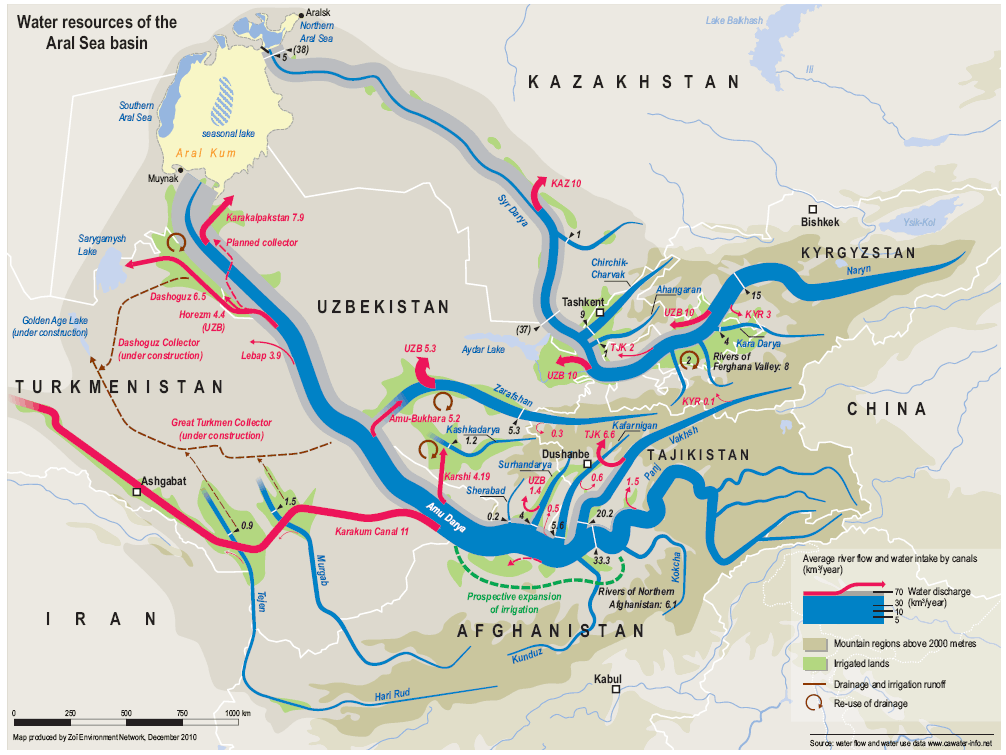
The first water war could very possibly happen in the countries just to the south of Russia. Central Asia has many water conflicts going on.

China has plans to build a canal to divert water from the Irtysh River to use in western China. The Irtysh River is a trans-boundry river that flows through Kazakhstanand into the Ob River in Russia.

ob riverDiversion of this water would affect 2.5 million people in Kazakhstan and another 1 million in parts of Siberia.

Tajikistan wants to build Dams (very big dams) on the Vakhsh River, a tributary of the Amu Darya River and another on the Syr Barya River. Both rivers feed into the Aral Sea which has already been devastated by Soviet diversion of water in past years. Both of the Dam projects would have devastating affects on the rivers as they flow into Kazakhstan,  Uzbekistan, and Turkmenistan. So far,  funding for the Dams seems to be what is holding the projects back.damtaj

WHAT ROLE WILL RUSSIA PLAY IN THE FUTURE

Russia, with its wealth of water, could be a major exporter of that commodity in the future. Oil, gas and power are already exported from Russia to its neighbors. Much like the oil pipeline that runs through Russia to parts of Asia and Europe, a water pipeline could be built. Major_russian_gas_pipelines_to_europeThis exploitation of water resources in Russia has many people very concerned. Talk of taking water from Lake Biakal for use in China is on the table, even though the Lake is designated as a World Heritage site. In February 2004, the Russia government drafted a new Water Code, allowing private ownership of rivers, lakes, and other water reservoirs. The government did offer one caveat, specifically stating that Baikal was not to be privatized. Deputy Minister of Economic Trade and Development Mukhamed Tsikanov has made it clear that Baikal is not for sale (RIA-Novosti, February 19, 2004).(Jamestown.org)

With much of the world facing a water crisis in the not to distant future, I see Russia as being a major power when it comes to water. They will have sole control, in Asia and Eastern Europe, of a vital resource. If the scarcity of water gets critical enough, it won’t matter if that water is polluted. In the mean time, I’m sure there are companies who will be willing to lend their expertise in cleaning up Russia’s pollution problem, for a price. Now is the time to buy stock in Russian water.

http://www.mnr.gov.ru/english/

http://www.country-data.com/cgi-bin/query/r-11390.html

http://www.worldsecuritynetwork.com/Russia/Valvo-Giovanni-/Russia-and-the-geopolitics-of-water-towards-a-new-Russian-order-in-Eurasia

seal video – http://waterengnet.com/2011/lake-baikal-the-pearl-of-siberia/

http://whc.unesco.org/en/list/754/

http://www.lakebaikal.org/Flora-and-Fauna.html

http://www.washingtonpost.com/blogs/wonkblog/wp/2012/08/10/where-the-worlds-running-out-of-water-in-one-map/

http://rt.com/business/russia-water-export-supply

http://www.jamestown.org/single/?no_cache=1&tx_ttnews[tt_news]=30480

Water Use by Industry


World wide , the majority of water usage goes to agriculture. According to the United Nations, 70% of water goes to agriculture, 22% to industry, and 8 % for domestic use  on average for the world. Industrial water usage increases with the country’s income. In Russia, the numbers look very different. Over sixty percent of Russia’s water usage goes to Industry.

Water Usage

Country

Agriculture

Industry

Domestic


World Wide

70%

22%

8%

Russia

18%

63%

19%

United States

41%

46%

13%

China

68%

26%

7%

United Kingdom

3%

75%

22%


droplets_590

INDUSTRY

Russia is a huge industrial country. Oil and Gas production is Russia’s largest industry, followed by non-ferrous metal production, steel making, nuclear and hydro power, transportation, mining and machinery production to name a few.

The Pulp and Paper industry is one of the heaviest users of water. Water is used at nearly every step in the pulp and paper making process. It takes 54 cubic meters of water for every metric ton of finished product. Paper mills discharge huge amounts of pollutants into the surrounding ecosystems. Russia with it’s vast forests has ample resources for the paper industry and the industry is expected to grow. One mill in particular has been attacked for the environmental impact it is having.baikalLake Biakal, which contains 20% of the world’s freshwater, has a paper mill on it’s banks. The mill has been there since 1966. The Russian government has finally decided to close the mill, but the actual closing won’t take place until 2020.

MUNICIPAL

Go to this website. The video does a great job of explaining how Moscow gets its water.moscow-water-fight-15

AGRICULTURE

Russia’s agriculture is limited by the amount of arable land that is available. Only 13% of all of Russia’s land is dedicated to agriculture. The most important crops grown are wheat, sugar beets,and potatoes. Cereal grains are also important, including maize, barley, oats, and rye. Irrigation canals are widely used. In 2010, Russia had a drought and the wheat crop was bad enough that the government banned wheat exports. Climate change will have an impact on Russia’s need to irrigate crops, but for now all it has done is lengthen the growing season by about 10 days. Record harvests were recorded in 2011 and Russia had issues with processing and storage of the crops.

Aral Sea

aral-sea-ships

In the 1960’s, Soviet Russia diverted the Syr Darya and the Amu Darya rivers to use the water for irrigation on the arid plains of Kazakhstan, Uzbekistan, and Turkmenistan.vod-res-bam-e These two rivers fed the Aral Sea, which at the time was the fourth largest lake in the world.

This is what the Aral Sea looks like today. aralsea_tmo_2012230

This is a NASA photo taken in 2011. The black outline shows where the waters edge used to be.

240px-Aral_Sea_1989-2008

Here is a before and after shot of the Aral Sea.

Energy Production

Russia produces lots of energy. Here’s the breakdown on energy , Russia has:

5 Geothermal plants

92 Hydroelectric plants

1 Tidal power station in Kislaya Guba

3 wind farms

12 operational Nuclear plants

23 thermal energy plants (burning coal, gas, oil).

Russia actually produces a surplus of energy and exports energy to other countries.

The Tidal power station was started in 1968, then shut down for 10 years. It reopened in 2004 when more funding became available. Russia has plans to build 2 more Tidal stations. It doesn’t look that impressive, but it puts out about half the MW of a Geothermal plant. It happens to be the world’s 4th largest Tidal station. Kislaya_Guba_tidal_power_station-6

MINING

Russia is one of the worlds top mineral producing countries. CIAMapUSSRCoalMineralDeposits1982-UT-PCLIt is a leading producer of aluminum, arsenic, asbestos, bauxite, boron cadmium, cement, coal, cobalt, copper, diamond, fluorspar, gold, iron, lime, magnesium, mica, natural gas, nickel, nitrogen,oil shale, palladium, peat (mineral?), petroleum, phosphate, pig iron, platinum, potash, rhenium,silicon, steel, sulfur, titanium. Russia ranks 6th in the world for gold production. Back during the Soviet days it was the worlds #1 gold producer. Mining is a large chunk of the economy for Russia.

The city of Norilsk, Russia is the worlds largest heavy metals processing centers, located beyond the Arctic Circle. It’s rated one of the top 10 polluted cities in the world.norilsk-russiaEven though the pollution is smog, it gets into the water cycle. Industry has a devastating effect on the water quality in Russia. During the Soviet days of Russia there was very little in the way of regulation and control when it came to waste water disposal from industry. The Russian Federation is trying to regulate what gets dumped into it’s waterways, but they still have an uphill battle ahead of them.

VODKA

398px-Vodka_Sobieski

Lets not forget Vodka production. Who can think of Russia without thinking of Vodka? It’s the national drink. Take potatoes and water, et voila! (it can be made from grains also) Did you know it takes about 15 gallons of water to produce 2 shots of Vodka. The average Russian drinks 5 gallons of vodka a year.

Sources:

 unwater.org

Droplet graph – http://www.circleofblue.org

Russia’s industry – http://www.nationsencyclopedia.com/economies/Europe/Russia-INDUSTRY.html

http://www.climateadaptation.eu/russia/en#agriculture-and-horticultur

http://www.fas.usda.gov/pecad2/highlights/2005/03/Russia_Ag/

NASA – http://earthobservatory.nasa.gov/Features/WorldOfChange/aral_sea.php

http://russianamericanbusiness.org/web_CURRENT/articles/926/1/Record-high-2011-harvest-exposes-problems-in-Russian-agriculture

http://www.cawater-info.net/aral/i/vod-res-bam-e.gif

http://www.who.int/water_sanitation_health/resourcesquality/wpccasestudy10.pdf

http://minerals.usgs.gov/minerals/pubs/country/2010/myb3-2010-rs.pdf

Water issues: Availability, Cost, Hygiene and Sanitation

There’s no shortage of water in Russia, but that water and it’s population are not evenly distributed across that huge country. russiamap2The major portion of the population and agriculture (Russia’s arable land is only 7% of their land mass) are in European Russia, where water is not as abundant.

The average Russian uses (residential use) 279 Liters (74 gallons) per person a day. In the U.S., we use 371 Liters (98 gallons) a day. They have indoor pluming , just like we do here in the U.S..Clean Water Denver Water says that we use 168 gallons per person. About 55% of that water is for outdoor use (we love our lawns). Water and Sewer costs in the U.S. is about $40 a month. Russians pay very little, if nothing, for the water they use. Below is a graph comparing a few Russian cities with some European cities.watergraphI read an interesting blog from a Russian (Masha Equpova) that grew up in Vladivostok, the largest eastern city in Russia. She claims that water conservation is non-existent in Russia. People use water as if it is unlimited.sewageThey also had no sewage treatment in that city until very recently. When the new treatment plant was completed, it had problems such as pipes not being hooked up properly. Bloggers got the word out that the plant had problems. The government finally took action and corrected the issues.

It is estimated that 35 – 60 percent of Russia’s drinking water does not meet the current sanitary requirements. This is a huge range, but it all depends on where you live in Russia.

The # 1 travel tip for Russia is DON’T DRINK TAP WATER. Use bottled water for drinking and brushing teeth. This is not only for bacterial and chemical issues, but for the look and taste of the water. Seventy-five percent of Russia’s surface water is polluted, 50 percent of all water is not potable and an estimated 30 percent of groundwater available for use is highly polluted.bottled_water

Unsanitary runoff from populated places and agricultural sites contributes heavily to the pollution of the water for domestic use. An estimated 8 percent of waste water is fully treated prior to dumping in waterways. Most water treatment facilities are obsolete, inefficient, and generally overwhelmed by the volume of material that now passes through them (Russian water quality).https://i0.wp.com/www.worldwater.org/sanco.gif

Many of Russia’s rivers are carriers of waterborne diseases. In 1995, Moscow city health officials reported an outbreak of cholera. The source of the cholera was the Moscow River. Moscow gets it’s drinking water from the Moscow river and the Volga. Officials have warned of increasing outbreaks of sewage-related diseases that include cholera, salmonella, typhoid fever, dysentery, and viral hepatitis from many other Russian rivers. In some areas, clean water is so scarce that water is imported from other regions.

Some Moscow neighborhoods have horrible water. Residents of a Moscow suburb protested about the brown sludge that they say has been coming out of the pipes for 20 years.moscow water

In 2008, Forbes magazine rated Moscow as #14 of the World’s Dirtiest Cities. This was based on the Mercer Health and Sanitation index score of 43.4 out of a possible 100 ( New York is 100 and some cities exceed 100).

A blog I ran across called “My Life with Babushka” gave the following lessons learned while living in Russia. babushkaBabushka is a scarf used to cover the head, it is also what elderly woman are called.

Lesson #1
In the mornings, it is very important to let the tap water run until it is very cold before filtering and boiling it for tea and coffee. Once, when Babushka suspected I had not followed her instructions, she dumped the pot of water I had already boiled and reboiled it with the COLD filtered water. You see, in Russia water sits in the pipes during the night and is warmer and browner than usual in the morning, so when it’s finally running cold, you know it’s not old pipe water. In the States, our water is not brownish/yellowish and is drinkable straight from the tap (although, some states have better water than others).

Lesson #7
It’s always a good idea to keep large jugs of water around in case the water supply is unexpectedly shut off. You will need them to flush the toilet, wash up, clean dishes, and boil for drinking water.

In the past few years , however, things are looking a little better for Russians and their water.  The Russian government is putting money aside to replace the existing infrastructure and to build water treatment and sewage plants. They plan to invest $20 billion in water management and infrastructure by 2020. This no doubt will raise the cost of water for Russians.

Click here to go to a video about Moscow’s water supply.

St. Petersburg actually has a Museum of Water that tells the history of water.

This is a fun video, but I don’t want to think what might be in the water.  http://www.liveleak.com/view?i=040_1361983498

References:

http://www.who.int/water_sanitation_health/dwq/en/

http://www.worldwater.org/data.html

http://georgiandaily.com/index.php?option=com_content&task=view&id=7676&Itemid=65

http://www.unwater.org/statistics_san.html

http://co.water.usgs.gov/infodata/wateruse.html

http://www.waterworld.com/articles/wwi/print/volume-26/issue-4/regulars/creative-finance/russian-water-and-wastewater-market.html

http://www.circleofblue.org/waternews/2009/world/russia-sees-water-infrastructure-overhaul/